Posts

VCE Algorithmics: The journey begins

Image
Today, I had my first class of VCE Algorithmics. This is a computer science course that will be part of the Victorian Certificate of Education for the first time in 2015. Like many other schools, we have a week's "headstart" at the end of this academic year. My class is made up of six girls and me. Four of the girls are in year 11 and the remaining two are in year 12. As for me, I am out of school and in my forties! We will learn much and solve many problems together and I have been waiting impatiently for the course to get under way. Given that the textbook is yet to be published, I took the opportunity of this week to lay some ground in "algorithmic thinking". The students looked at a few algorithms today and decided what each of them accomplished. Here is one. Do you know what it does? If you want to work it out for yourself, stop reading!

Wonderful advice to young women at the "Go Girl, Go for IT" conference

Today, two colleagues of mine and I accompanied 46 year 9 and 10 girls to the Go Girl conference at Deakin University. After a warm welcome by program director, Fi Slaven, the presentations started with the day's conference patron, Karen Stocks, Managing Director of Twitter Australia ( @ KazStocks ). Karen gave the students 3 pieces of advice: It is okay not to have a life plan. Follow passions, dreams. Do something that makes your heart beat faster. Trust that you'll end up somewhere good. Education, education, education. Don't just get a degree, do well. Good grades will show that you can apply yourself. You will earn credibility through sustained performance. Be humble, patient and respect your elders, even when you feel that you're the smartest person at the table. Next up was Tammy Butow ( @ tammybutow ) , senior digital strategist at NAB. It was inspiring to see someone achieve so much at such a young age. She encouraged the girls to build pr...

A class that showed me what learning looks like

Last year, I began teaching an elective class in year 10 called "Big Ideas in Computer Technology". The first class had 12 girls in it and, this year, the number grew to 17. I was blown away with the number since, in year 10, the girls can take only three electives across the year and the offerings at our school are mind-boggling. How the learning was structured This year, I really wanted to work with a principle I learnt from a video by James Paul Gee which I reviewed earlier . Using computer games as a metaphor, I saw my role as designing the learning in such a way that the students could have enough guidance at the beginning - the first two levels of the game - and then learn through experimentation, discussion and some help from me.

Educational beliefs I have let go of

Before becoming a teacher, I used to assume that kids couldn't know things unless they were taught them. I really thought that a comprehensive curriculum and rigorous tests were the way to ensure a quality education. Every time I encountered kids who seemed to struggle with basic numeracy, I would mumble something about the school system lacking rigour. In this post, I want to list some of the beliefs that I no longer hold. Here are four beliefs I used to hold but no longer do: Students learn what we teach them It is a well-established fact that students construct their own learning and that this construction is influenced by many factors, including what teachers say or demonstrate. I know many teachers, myself included, who finish correcting their students' papers and exclaim: "I told them ...." or "was I even in the room when we discussed this?" At times, I still express my frustration this way but I am no longer surprised when students do not interna...

Learning in "Passion Communities"

Image
This video by James Paul Gee is an absolute gem. One idea I want to discuss here is his vision of people learning in what he calls "passion communities". Passion communities form around video games, popular books and hobbies. Fans of Harry Potter go on sites where they write their own fiction stories in that genre. World of Warcraft gamers develop the skill of solving problems in groups. So, what are the features of a "passion community" (ideas taken from the video): They solve problems collaboratively: The group is smarter than the individual. Learning happens on demand: In a game, progressive levels introduce you to the skills and language you need to succeed. You don't acquire knowledge in a vacuum and expect to apply it later. They are not age-graded. People of different ages can contribute and learn. The same teacher can mentor one time and be mentored at another time. The community sets high standards and provides honest feedback to help its...

Seymour Papert, a Roman Temple and EdTech today!

Image
In 2009, I lived a childhood dream by visiting the Roman temple of Jupiter in Baalbek, Lebanon . The temple was built by many generations of Roman engineers, artisans and slaves. The stones used could not be found in that valley location, so the Romans brought them by sea, used elephants and slaves to drag them up a mountain and then down to the right location. There, they would be carved and set in place. The grandeur of the pillars and the intricate work still visible today spoke of the glory that the Romans wanted the place to have. I remember thinking that we had the technology to execute such grand projects in a much shorter time. It was the ambition we lacked. Some time later, I came across this video by Seymour Papert . In it, Papert shows the use of the Logo programming language to control a "turtle" either on the screen or on a physical surface. By manipulating the turtle, students can create shapes, animations or music that are personally meaningful. While doing th...

Watching students grow: A week in the life of this teacher

Image
In this, my 100th post, I want to reflect on some of the things that make me grateful to teach at Avila College. The last week was exhausting and energising at the same time. I believe a summary of that week will suffice in explaining why I love working at Avila. Here is a snapshot: World Integrated Unit For three days, groups of Year 7 students formed their own countries. They learnt about preferential voting, designed a national flag, dance, anthem, sandwich and animal! Each country had to conduct a campaign to host the Olympic games and use social media to their advantage. Treasurer, financial adviser and head of state deciding their country's investment priorities My role was to look after the treasury and guide and the individual country treasurers through foreign exchanges and a financial report.

Why use algebra when you can use arithmetic?

Image
This post was jointly written with my colleague, Steven Francis. It follows from my earlier post, Welcome to Maths class: Leave your common sense at the door . In this post, we provide examples that highlight the importance of allowing students to solve problems from first principle. At times, insisting on specific formal methods can diminish students' ability to solve problems. In the video above, the renowned physicist Richard Feynman relates how he could solve linear equations early but was told "You did it with arithmetic. You have to do it with algebra." Feynman then reflects with visible annoyance: There's no such a thing as you don't do it by arithmetic, you do it by algebra. It's a false thing that they had invented in school so that the children who have to study algebra can all pass it. They had invented a set of rules which you follow them ( sic) without thinking to produce the answer.

Should kids learn times tables?

Image
Knowing that I teach year seven mathematics, people often ask me my opinion on whether kids should learn their times tables (or multiplication tables if you prefer). In this post, I argue that times tables should be learned at some stage of the child's education, but only as part of many ideas related to multiplication. (c) Can Stock Photo Firstly, multiplication tables should not be learned too early. My kids' primary school holds off till kids reach grade 3. A kid who "knows the answer" to 3x8 will not feel the need to group objects in threes or in eights and will miss discovering a few things about multiplication:

My reflections on Day 2 of the VITTA conference

This year, like the previous two years, three students and I ran a workshop on mobile APP development using Corona SDK at the annual conference of the Victorian IT Teachers Association. In this post, I will reflect on the workshop itself, the keynote given by Adam Eliot and other happenings at the conference. I started the day early and was in front of the school by 7:10am. I was waiting to drive with three students to the Caulfield Racecourse, where we were to attend the annual VITTA conference. The girls were punctual and we left Avila at 7:30am. Upon arrival, we parked and registered. There were tags and show bags for each of us. The girls loved the freebies. As soon as we checked out the room we were to present in, we went down to the expo and they moved around the exhibits, collecting highlighters, pens and stress balls! We then moved on to the keynote which was given by Oscar-winning animator Adam Eliot. It was a very entertaining speech and we had time to ask questions. He...

Welcome to Maths. Please leave your common sense at the door

Image
I come across many students who feel that it is unacceptable to solve a Maths problem on first principles. They always go searching for a formula and, when none can be found, give up on the problem. In this blog post, I give two examples to illustrate this phenomenon. What is five percent of 100? Last term, I put a question to my year 7 class which involved calculating 5% of $250? We had not covered percentages yet and I wanted to see how they would approach this. Some students had little difficulty with the calculation although the majority decided they couldn't do percentages. Some tried to remembered a formula they had learnt earlier. Mr Baroudi, do you multiply by 100 over 1 or do you divide by 100 over 1? I told them not to worry about any formal methods for the time being. Instead, I asked them, "What does 'per cent' mean?" Everyone seemed to know it meant "out of 100". I drew the diagram below, one step at a time, asking them, ...

A remarkable class that taught me as much as I taught it

Image
This year, I offered a class for the first time to the school's year 10 students: Big Ideas in Computer Technology. The course was inspired by a lecture I had watched on Youtube in which Dr Daniel Garcia of UC Berkeley presents the idea of CS Principles, an advanced placement course being offered at some US high schools in a bid to foster greater interest in Computer Science among school-aged students.

Building an APP with students: The joys and lessons

Image
On January 23rd, 2013, the Avila College APP Group's APP, Lock Spin, went live on the App Store. A few days earlier, it had been available from Google Play. In this post, I reflect on some of the lessons I drew from this experience. The idea behind Lock Spin was to help incoming year 7s learn how to use their combination locks. It also turned a familiar item at school into something we could have fun with. Before I go any further, these are the links for downloading the APP: App Store:      https://itunes.apple.com/us/app/lock-spin/id594413665?ls=1&mt=8 Google Play:    http://goo.gl/2C9ZF

Five benefits of learning with a friend

Image
Learning with a friend Throughout this year, I have been undertaking small learning projects with my friend and colleague, Steven Francis. I find our learning sessions invigorating and a large part of what I like about my workplace. In this post, I share some advantages of learning with a friend. (c) Can Stock Photo Steven and I have established a weekly ritual that has turned Friday afternoon from a draining time of the week into an enjoyable one: Every Friday after school, we pack up our our weekend corrections and head to a close-by eatery. We indulge in vegetarian pastries, soft drinks and some potato chips as we have a casual and, at times, cathartic chat (yes, men have those too!). After about 30 minutes, we head back to school and work on a learning project for about two hours. The common thread of our projects this year has been computer programming.

Three students at a teachers' conference

Image
For the second year running, I had the privilege of taking three students to the VITTA annual conference to present a workshop on developing APPs using Corona SDK. This year, I took Ally from year 8, Yara from year 9 and Ping from year 11 (not their real names!). All three are members of the Avila College APP Group.  Preparation In  my reflection on last year's experience , I wrote that 5 weeks would be needed to prepare the students. Unfortunately, this year's conference was at the start of week 4 of the school term. Starting at the end of the last semester would have been impractical as it would have clashed with exams and report-writing. Still, we met twice a week and the girls ran one of the APP Group meetings as a rehearsal.

Jessica's solution to a loopy problem

Image
A well known algorithm, taught in Number Theory classes at tertiary level, is Euclid’s algorithm for finding the Greatest Common Divisor (GCD) of two numbers. In Australia, we tend to refer to the GCD as the Highest Common Factor. In this post, I describe the algorithm and present a year 8 student’s program that implements it. The Algorithm To illustrate what the GCD of two numbers is, let’s consider a 21 x 15 rectangle.

The first APP Group meeting of 2012

Image
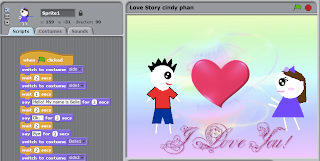
Today we had the first meeting for this year's APP Group. According to returned permission forms, the group should have 37 student members. The attendance today was 34. I was also joined by two of my colleagues, Steven and Colleen. The latter has been reading Seymour Papert lately and has learnt that Scratch was created by one of his students, Mitchell Resnick.

Why girls should learn computer programming

Image
Lately, I have made a case for programming in the curriculum and my colleague, Sarah Macdonald, wrote about using Scratch to help students "understand their own problems, make mistakes and explore alternatives" . This post is a manifesto for teaching girls in particular how to program. In it, I argue that this is an essential skill for girls to help make the future rather than see innovations as black magic which they may only consume. Samantha (Year 9) : "I have a friend who wrote a program that generates bibliographies for his school work." Me: "That's great. How would you like to learn to write your own programs?" Samantha: "No, Mr. Baroudi. That's what boys' schools are for!" Picture from: canstockphoto.com

Beyond teaching programming: Scratch as a constructivist learning environment

Image
This is a guest post is the second in a series (you can read the first post here ) and is written by my colleague Sarah Macdonald. In it, Sarah tells about teaching Scratch for the first time to her year 7 girls. Flashback, 2010 End of year curriculum planning meeting.  Students departed.  Reports written.  Teachers fatigued... and my Head of IT has just announced a major change in the IT curriculum for the following year.  We will be teaching Scratch.  What do I know about Scratch?  I know it’s about programming and primary schools are using it to create endless cartoons about a yellow cat.  Why Scratch?  I realise I have a lot to learn.

Every child should learn computer programming

Image
In a previous post , I have listed a few reasons for teaching programming in school. In this post, I intend to argue that computer programming is an essential skill in the curriculum. I was prompted to write it when I read the following comments made by Steve Jobs: "In my perspective ... science and computer science is a liberal art, it's something everyone should know how to use, at least, and harness in their life. It's not something that should be relegated to 5 percent of the population over in the corner. It's something that everybody should be exposed to and everyone should have mastery of to some extent, and that's how we viewed computation and these computation devices." ( http://www.npr.org/2011/10/06/141115121/steve-jobs-computer-science-is-a-liberal-art?sc=tw&cc=share )